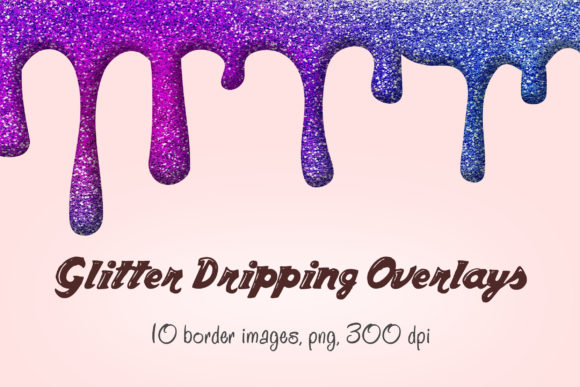
Glitter Dripping Overlays
In the landscape of digital design, visual impact often hinges on subtle yet deliberate textural choices. Among the various assets available to creators, Glitter Dripping Overlays have emerged as a distinct tool for adding depth, movement, and a touch of luxury or playfulness to static compositions. This resource set provides ten high-resolution PNG files featuring translucent, glitter-like drips against transparent backgrounds. For professionals ranging from graphic designers and marketers to small business owners and content creators, understanding the technical specifications and practical applications of such assets is essential for maintaining workflow efficiency and aesthetic quality.
The primary value proposition of this specific collection lies in its balance between visual richness and technical usability. Each overlay is rendered at 300 DPI, ensuring that the intricate details of the simulated glitter particles remain crisp even when scaled or printed. The standard width of approximately eleven inches per image offers sufficient coverage for most social media graphics, blog headers, and marketing materials without requiring complex tiling or repetition. By providing these assets in PNG format with transparency, the creator allows for seamless integration into existing projects, whether the background is dark, light, or patterned.
Technical Specifications and Image Quality
Evaluating any digital asset begins with an examination of its technical foundation. The inclusion of 300 DPI resolution is a critical factor for those who intend to use these overlays in print-ready materials. Many free or low-cost stock images are optimized solely for screen display (72–96 DPI), which results in pixelation or blurriness when enlarged for physical products like business cards, flyers, or packaging. With these Glitter Dripping Overlays, the density of the glitter effect remains consistent regardless of the output medium, provided the final dimensions do not exceed the original file size significantly.
The transparent background feature is equally important. In digital compositing, the ability to layer elements without manual masking saves considerable time. When placed over a vibrant gradient, a solid color block, or a photographic background, the drip effect appears to float naturally. This characteristic allows designers to maintain the integrity of their underlying composition while adding a focal point of texture. The varying opacity inherent in the glitter simulation ensures that the overlay does not completely obscure the content beneath it, preserving readability and visual hierarchy.
Practical Applications Across Industries
The versatility of Glitter Dripping Overlays makes them suitable for a wide array of professional contexts. For marketers and social media managers, these assets can elevate standard promotional posts. A product launch announcement or a limited-time offer benefits from the eye-catching nature of dripping textures, which guide the viewer’s attention toward the central message. The "drip" motif implies fluidity and abundance, subconsciously reinforcing themes of generosity or premium quality.
Small business owners and entrepreneurs frequently utilize these overlays for branding consistency. Whether designing email signatures, invoice templates, or website banners, the addition of a subtle glitter accent can differentiate a brand from competitors who rely on flat, minimalist designs. For businesses in the beauty, fashion, or lifestyle sectors, where aesthetics are paramount, these overlays provide a quick way to inject personality into corporate communications without commissioning custom illustrations.
Freelancers and bloggers may find particular utility in these files for creating featured images or downloadable resources. When offering lead magnets such as checklists or guides, wrapping the content in visually appealing overlays increases perceived value. The ten variations included in the set allow for rotation, preventing visual fatigue if the same design element is used across multiple campaigns or blog posts over an extended period.
Workflow Integration and Usability
Integrating Glitter Dripping Overlays into a design workflow requires minimal learning curve but yields significant creative flexibility. In software such as Adobe Photoshop, Canva, or Affinity Designer, users can simply drag the PNG file onto their canvas. Adjusting the blend mode—often setting it to "Overlay," "Soft Light," or "Multiply"—can further enhance the interaction between the glitter and the background colors. This adaptability means that a single overlay can appear golden on one background and silver or iridescent on another, depending on the lighting conditions simulated by the underlying layers.
However, effective usage demands restraint. Because glitter effects are inherently busy and reflective, they compete for visual attention. Professional judgment dictates that these overlays should serve as accents rather than dominant elements. Overusing them can clutter a design, making text difficult to read and reducing overall professionalism. The recommended approach is to place the drip strategically, perhaps cascading from a headline or framing a call-to-action button, ensuring that the composition remains balanced and focused.
Strengths and Limitations
The strengths of this resource pack are clear: high resolution, convenient sizing, and broad compatibility. The fact that there are ten distinct images provides enough variety for ongoing projects without overwhelming the user with redundant options. The 11-inch width is a practical compromise, large enough to be impactful but small enough to keep file sizes manageable for web delivery.
Conversely, potential limitations exist. As with any pre-made asset, the style is fixed. If a designer requires a highly specific color palette or a unique shape that deviates from the provided templates, customization may be necessary. Additionally, because the effect simulates light reflection, it may not render accurately on all monitors or under different viewing angles. It is also worth noting that while the PNGs are high quality, they are raster-based. This means they cannot be infinitely scaled up without loss of detail, unlike vector-based alternatives. For most digital applications, however, this limitation is negligible.
Who Should Consider This Resource?
This collection is particularly well-suited for individuals who prioritize speed and aesthetic appeal in their design process. Non-designers using template-based platforms will appreciate the ease of use, needing only basic knowledge of layering to achieve professional results. Experienced designers may use these overlays as base textures to build upon, adding additional effects or typography to create more complex scenes.
It is less ideal for projects requiring strict minimalism or corporate neutrality, where the playful nature of glitter might clash with the desired tone. Furthermore, if a project involves massive-format printing (such as billboards), the 11-inch width would require significant scaling, potentially compromising the sharpness of the individual glitter particles. In such cases, vector-based glitter brushes or higher-resolution source files would be more appropriate.
Final Assessment
Ultimately, Glitter Dripping Overlays represent a practical and high-quality addition to a digital asset library. They address a common need for decorative elements that convey texture and movement without the overhead of custom creation. By adhering to professional standards in resolution and format, they ensure reliability across both digital and print mediums. For creators looking to add a layer of sophistication or excitement to their work, these overlays offer a straightforward, effective solution. The key to success lies in thoughtful application, using the assets to enhance rather than dominate the visual narrative.